Executive Summary
Paper 5 completes the AI Governance and Value Delivery Framework Series by providing the reference assets required to implement the framework consistently across projects, programs, portfolios, products, operational AI capabilities, governance capabilities, and AI-enabled transformation initiatives.
The companion papers define the conceptual, operating, practical, and future-state intelligence layers of the framework. Paper 5 converts those layers into a reusable asset library: reference catalogs, governance registries, templates, checklists, glossary terms, evidence packs, and implementation guidance.
The purpose of Paper 5 is practical adoption. It enables organizations to classify initiatives consistently, assign governance profiles, document Human-in-Command authorities, map benefits and net impact, define governance triggers, collect evidence, support assurance, and prepare information for future governance dashboards, semantic repositories, governance copilots, governance agents, and Semantic PMO capabilities.
Paper 5 should not be treated as a static forms package. The assets described here are governance instruments. They standardize language, improve traceability, support decision quality, and create auditable evidence that governance is being exercised rather than merely asserted.
Central message: implementation assets are not administrative overhead. They are the evidence layer through which value, accountability, risk, benefits, and governance decisions become traceable.
Figure 1 - Paper 5 Asset Architecture
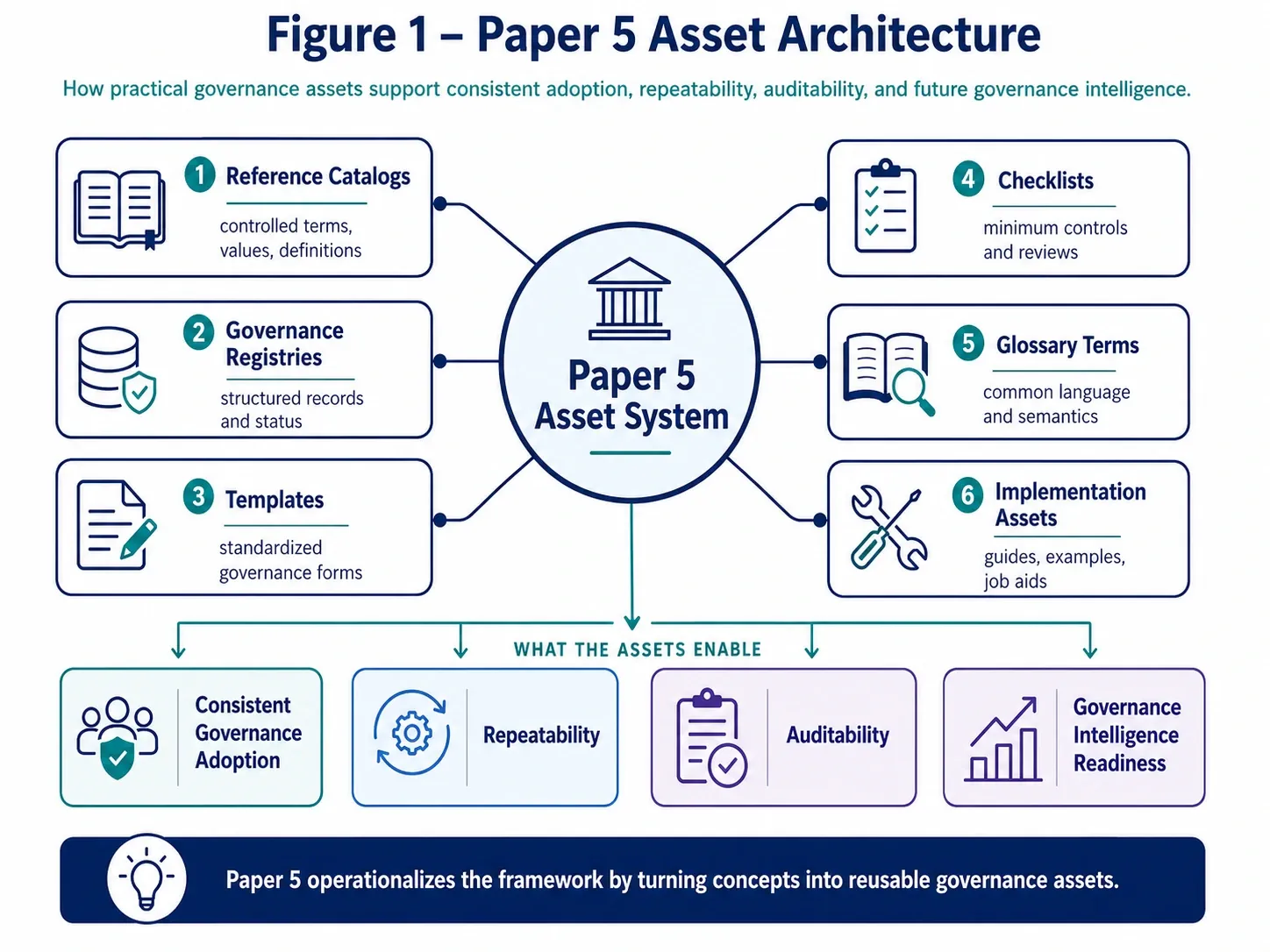
A model showing how reference catalogs, registries, templates, checklists, glossary terms, and implementation assets support consistent governance adoption.
Figure 1. Paper 5 Asset Architecture.
1. Introduction
1.1 Context
AI-enabled initiatives require repeatable governance artifacts because they operate under conditions of uncertainty, data dependency, adaptive behavior, regulatory evolution, human impact, and changing benefit realization. Without common assets, organizations often rely on inconsistent terminology, fragmented evidence, uneven governance reviews, and subjective risk interpretation.
Paper 5 provides the implementation layer that makes the framework usable at scale. It is designed for organizations that need practical instruments rather than abstract principles alone.
1.2 Relationship to Companion Papers
Table 1. Relationship of Paper 5 to the framework series.
| Paper | Primary Contribution | Paper 5 Dependency |
|---|---|---|
| Paper 1 | Ontology, taxonomy, semantic relationships, value delivery logic, Human-in-Command governance. | Converts concepts into controlled catalog terms and glossary entries. |
| Paper 2 | Governance operating model, triggers, escalation, override, lifecycle governance, drift, portfolio governance. | Provides registries, checklists, escalation templates, and decision records. |
| Paper 3 | Practical application methods, classification, benefit mapping, governance profiling, implementation guidance. | Provides reusable worksheets, business case templates, and implementation packs. |
| Paper 4 | Governance intelligence roadmap, knowledge graphs, dashboards, copilots, agents, Semantic PMO. | Provides semantic metadata templates, registry structures, and evidence models for future intelligence. |
| Paper 5 | Reference structures, catalogs, registries, templates, glossary, and implementation assets. | Completes the operational adoption package. |
1.3 Guiding Principle
Governance assets should make decisions clearer, not slower. Every template, catalog, registry, and checklist should support at least one of four outcomes: better value realization, stronger accountability, clearer risk control, or improved readiness for governance intelligence.
2. Purpose and Scope of Paper 5
2.1 Purpose
The purpose of Paper 5 is to provide a practical reference asset library for implementing the framework. The assets are intentionally reusable and can be tailored by organizational context, regulatory environment, governance maturity, portfolio size, risk exposure, and AI capability type.
2.2 Paper 5 Objectives
- Provide controlled reference catalogs for consistent terminology and classification.
- Define governance registries that convert decisions, authorities, triggers, benefits, and evidence into auditable records.
- Provide templates that support business cases, classification, governance profiles, Human-in-Command design, benefit mapping, assurance, and lifecycle governance.
- Define glossary terms that support semantic consistency across Papers 1 to 4.
- Support future knowledge graph, dashboard, copilot, agent, and Semantic PMO readiness.
- Enable implementation teams to adopt the framework progressively rather than as a single enterprise-wide burden.
2.3 Scope
Table 2. Paper 5 scope boundaries.
| Included | Not Included |
|---|---|
| Catalog fields, registry structures, templates, checklists, evidence pack guidance, glossary terms, and implementation playbooks. | Legal advice, procurement-specific contract language, jurisdiction-specific regulatory interpretation, or technical architecture specifications. |
| Governance-ready structures that can be tailored by PMOs and governance boards. | A mandatory one-size-fits-all process model. |
| Reference structures that support future governance intelligence. | A requirement to implement knowledge graphs, copilots, or agents immediately. |
3. Paper 5 Asset Architecture
3.1 Asset Categories
The Paper 5 asset architecture is organized around six asset families. Each asset family supports a different governance need and creates a different kind of evidence.
Table 3. Paper 5 asset families.
| Asset Family | Purpose | Primary Users |
|---|---|---|
| Reference Catalogs | Standardize controlled vocabulary, categories, profiles, and reusable governance classifications. | PMO, governance board, delivery teams, assurance teams |
| Governance Registries | Maintain auditable records of initiatives, authorities, decisions, triggers, benefits, risks, controls, and evidence. | PMO, governance office, auditors |
| Templates | Provide repeatable structures for business cases, classification, benefit mapping, assurance, and governance decisions. | Sponsors, business case authors, project teams |
| Checklists | Support repeatable review at key gates and lifecycle stages. | Governance boards, PMO, assurance teams |
| Glossary | Maintain semantic consistency across the framework. | All users; future semantic repository owners |
| Implementation Packs | Package assets by user role, lifecycle stage, and adoption phase. | PMOs, change leads, governance implementation teams |
3.2 Asset Design Logic
Each asset should define: purpose, scope, owner, required fields, optional fields, evidence requirements, approval rules, review cycle, and relationship to future governance intelligence. This keeps the asset library manageable and prevents uncontrolled proliferation of forms.
Figure 2 - Reference Catalog Structure
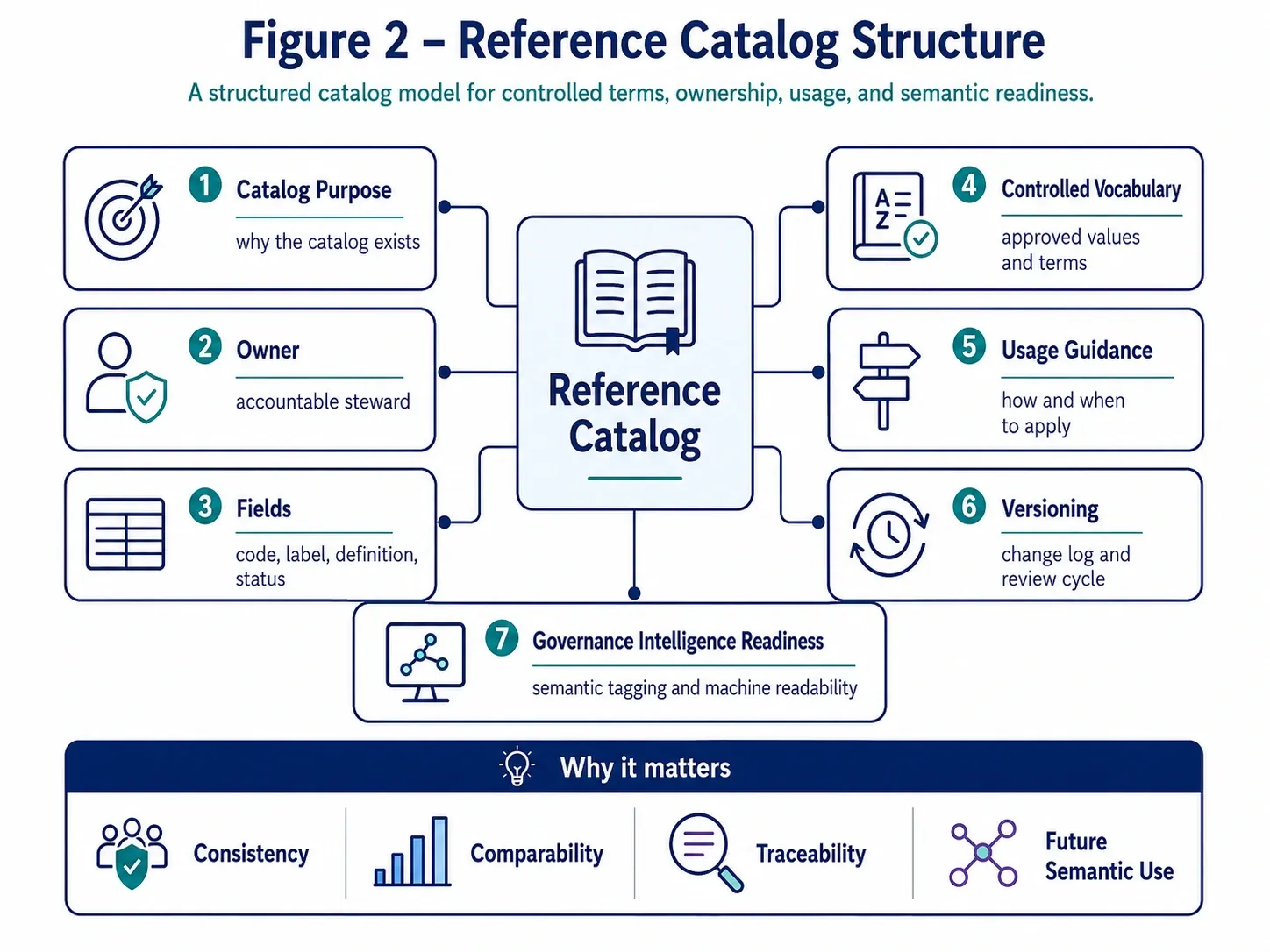
A structured catalog model showing catalog purpose, owner, fields, controlled vocabulary, usage guidance, versioning, and governance intelligence readiness.
Figure 2. Reference Catalog Structure.
4. Reference Catalog Design
4.1 Purpose of Reference Catalogs
Reference catalogs provide controlled values for classification, governance tailoring, benefit mapping, trigger assignment, assurance planning, and future semantic tagging. They reduce ambiguity by ensuring that the same terms mean the same thing across initiatives and governance reviews.
4.2 Catalog Metadata Standard
Table 4. Standard catalog metadata fields.
| Field | Description | Governance Use |
|---|---|---|
| Catalog Name | Unique name of the catalog. | Supports asset identification and ownership. |
| Catalog Owner | Role accountable for maintaining the catalog. | Prevents uncontrolled changes. |
| Controlled Term | Approved vocabulary value. | Supports consistent classification. |
| Definition | Clear meaning of the term. | Reduces interpretive variation. |
| Usage Guidance | When and how the term should be applied. | Supports consistent reviews. |
| Examples | Illustrative use cases. | Improves adoption and training. |
| Related Terms | Links to terms in other catalogs. | Supports semantic readiness. |
| Version | Catalog version and effective date. | Supports auditability. |
4.3 Catalog Governance Rules
- Only approved catalog owners may create, retire, or modify controlled terms.
- Catalog changes should be versioned and communicated to users before new templates are released.
- High-use catalogs should be reviewed at least annually or when regulation, standards, organizational strategy, or operating models change.
- Deprecated terms should remain visible for audit purposes but should be clearly marked as retired.
Figure 3 - Governance Registry Model
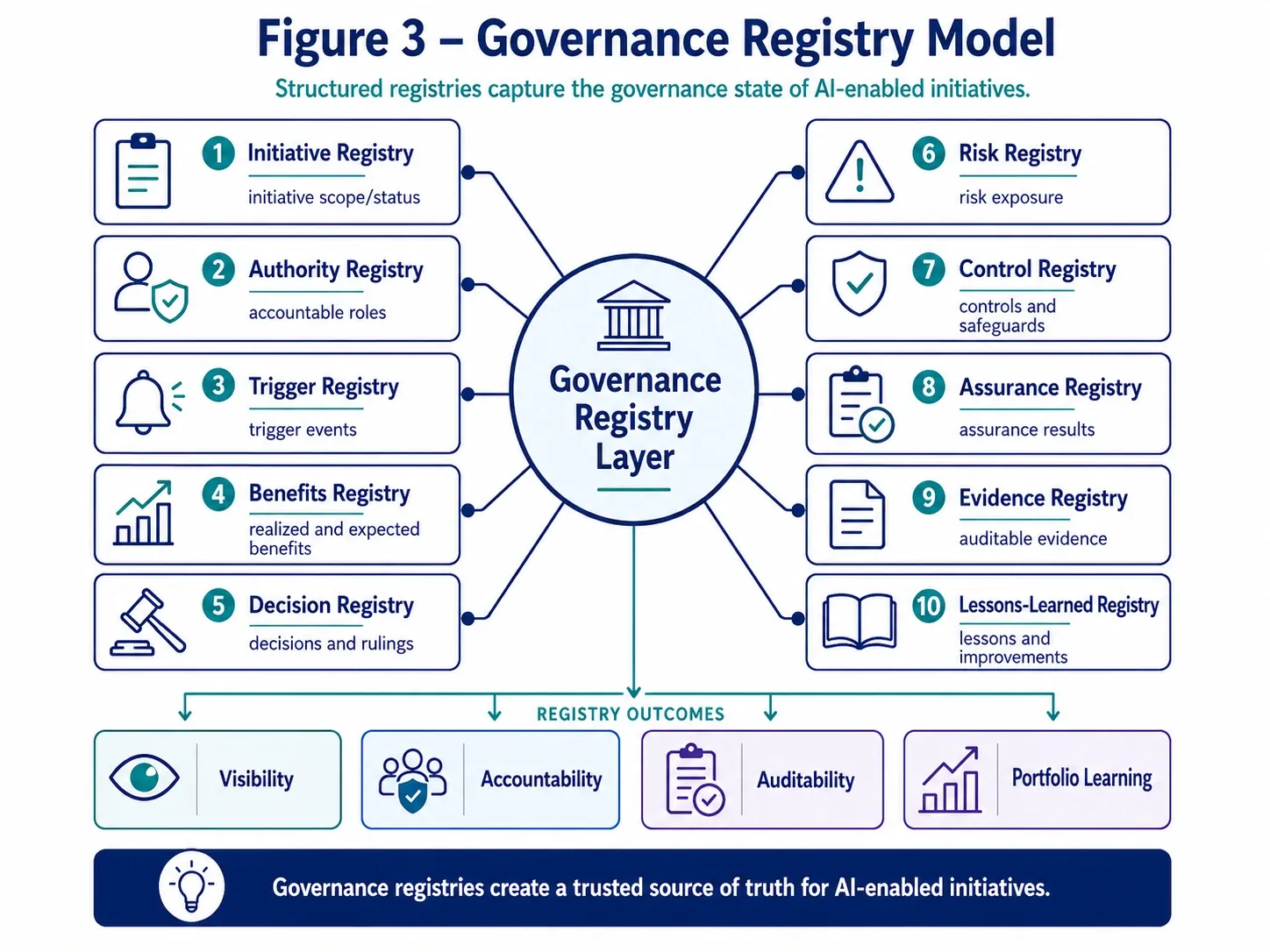
A registry model showing initiative, authority, trigger, benefits, decision, risk, control, assurance, evidence, and lessons-learned registries.
Figure 3. Governance Registry Model.
5. Canonical Reference Catalogs
5.1 Core Catalog Set
The following catalog set supports implementation of the framework. Organizations may add sector-specific terms, but the core terms should remain stable to preserve comparability.
Table 5. Core reference catalog set.
| Catalog | Example Values | Used By |
|---|---|---|
| AI Role in PPPM Catalog | PPPM tool; project deliverable; operating capability; governance capability. | Classification worksheet, business case, portfolio review. |
| AI Capability Type Catalog | Generative AI; predictive analytics; optimization analytics; workflow automation; retrieval-augmented generation. | Use case assessment, assurance planning. |
| AI Problem Pattern Catalog | Recognition; prediction; anomaly detection; conversational interaction; decision support; optimization; autonomous system. | Governance profile assessment, risk assessment. |
| Business Intent Catalog | Cost reduction; revenue growth; risk reduction; service improvement; compliance; sustainability; resilience. | Business case, benefit mapping. |
| Governance Profile Catalog | Low-risk assistive AI; Human-in-the-Loop AI; Human-on-the-Loop AI; Regulated AI; High-Impact AI; Autonomous AI; Human-in-Command AI. | Governance profile assignment. |
| Trigger Category Catalog | Financial; operational; benefit; ethical; regulatory; data; vendor; human impact; sustainability; safety; strategic. | Trigger register, monitoring plan. |
| Severity Catalog | Informational; moderate; significant; critical. | Trigger response and escalation workflow. |
| Decision Catalog | Approve; approve with conditions; reassess; pause; adapt; retire. | Board decision record. |
5.2 Catalog Tailoring
Catalogs should be tailored by adding local examples, sector-specific triggers, and regulatory references. Tailoring should not remove the core categories unless an organization deliberately creates a controlled mapping table from local terminology to the framework terminology.
6. Governance Registry Model
6.1 Purpose
Governance registries convert governance activities into structured records. A registry is not merely a list; it is a controlled evidence structure that supports traceability, review, accountability, and future intelligence.
6.2 Core Registries
Table 6. Core governance registries.
| Registry | Minimum Record | Primary Governance Question |
|---|---|---|
| AI Initiative Registry | Initiative ID, owner, objective, capability, governance profile, lifecycle stage. | What AI-enabled initiatives exist and how are they governed? |
| Authority Registry | Named strategic, governance, operational, override, value, and benefits authorities. | Who remains accountable? |
| Decision Registry | Decision, date, decision maker, evidence, conditions, next review. | What governance decisions were made and why? |
| Trigger Registry | Signal, trigger category, severity, owner, response, closure. | What conditions require governance action? |
| Benefits Registry | Expected benefit, metric, baseline, target, owner, status. | Are benefits being realized? |
| Risk and Control Registry | Risk, control, owner, assurance activity, residual exposure. | Are governance controls adequate? |
| Evidence Registry | Evidence item, source, date, related decision, retention rule. | What evidence supports governance claims? |
| Lessons-Learned Registry | Finding, context, action, reusable pattern. | What knowledge should be reused across the portfolio? |
Figure 4 - Template Operating System
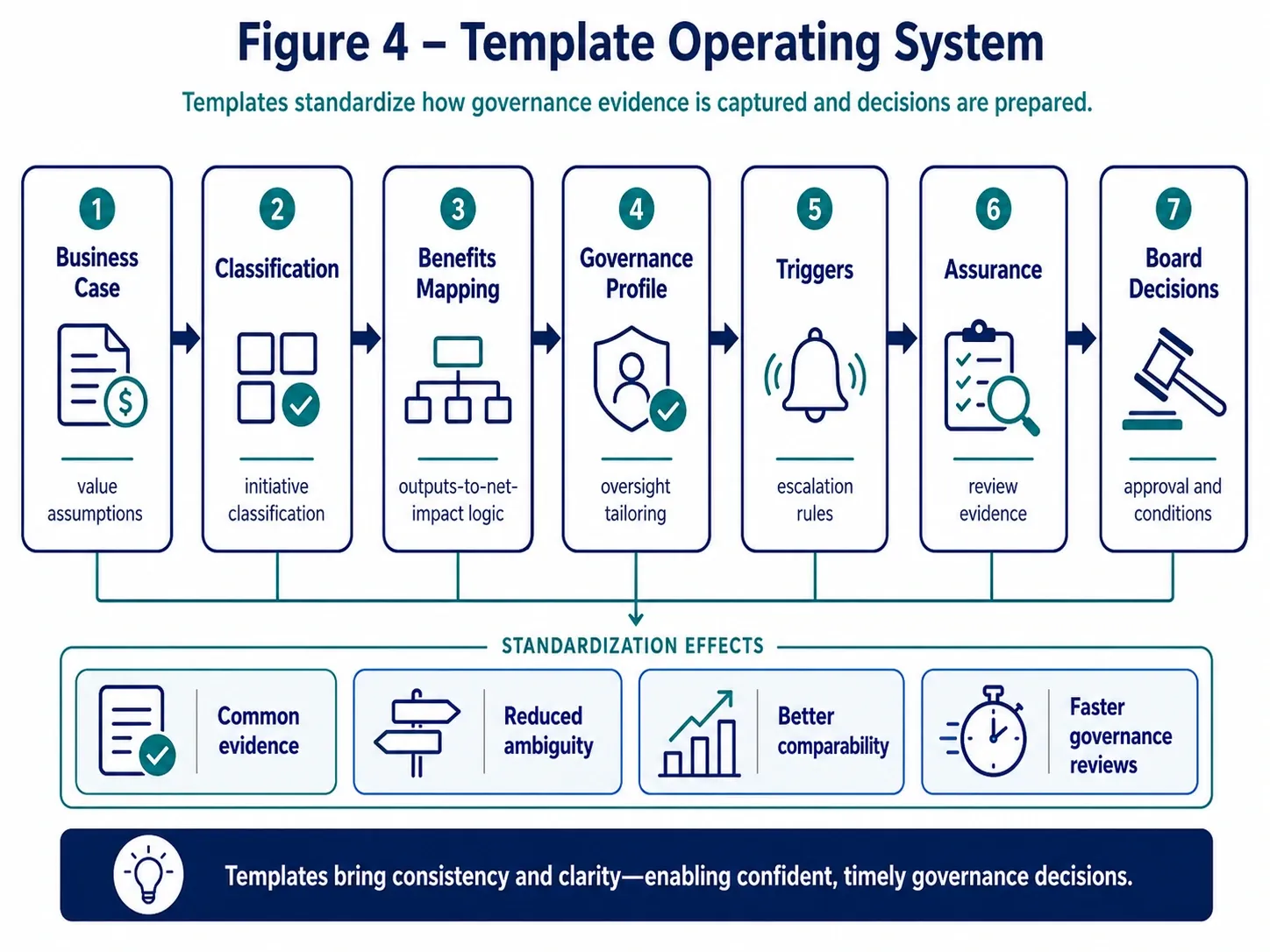
A process showing how templates standardize business cases, classification, benefits mapping, governance profiles, triggers, assurance, and board decisions.
Figure 4. Template Operating System.
7. Template Design Principles
7.1 Templates as Governance Instruments
Templates should be treated as governance instruments rather than administrative forms. A well-designed template clarifies decision criteria, standardizes evidence, reduces rework, and enables portfolio-level comparison.
7.2 Template Principles
- Each template should have a defined owner, version, and review cycle.
- Each mandatory field should connect to a governance decision or evidence requirement.
- Templates should avoid collecting information that no governance role uses.
- Templates should separate facts, assumptions, forecasts, evidence, and recommendations.
- Templates should be structured enough for future metadata extraction and semantic mapping.
7.3 Template Operating System
The template operating system links the business case, classification worksheet, governance profile, benefit map, trigger register, assurance plan, decision record, and evidence pack. Together, these templates form a governance file for each AI-enabled initiative.
A lifecycle showing create, approve, publish, use, capture evidence, review, revise, retire, and archive assets.
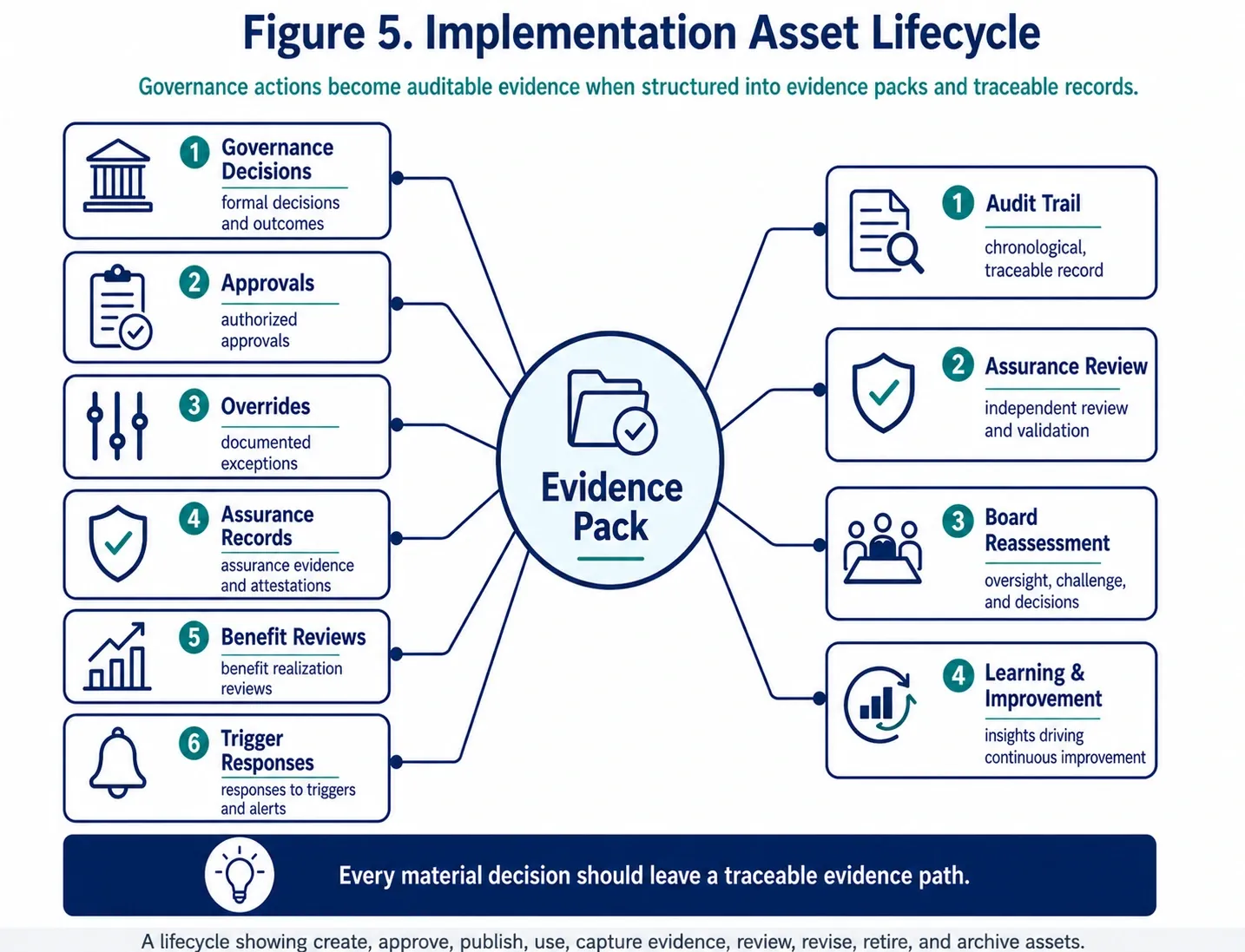
Figure 5. Implementation Asset Lifecycle.
8. AI Initiative Definition and Use Case Template
8.1 Purpose
The initiative definition template establishes the minimum information required to identify, classify, and govern an AI-enabled initiative. It should be completed before detailed solution design and updated when the initiative materially changes.
8.2 Required Fields
Table 7. AI initiative definition template.
| Template Field | Guidance | Evidence / Source |
|---|---|---|
| Initiative Name and ID | Use a unique identifier that links to the portfolio registry. | Portfolio system, PMO registry. |
| Sponsor | Name the executive or accountable sponsor. | Sponsorship record. |
| Organizational Objective | State the objective the initiative supports. | Strategy map, business plan. |
| Business Capability | Identify the capability being enhanced or created. | Capability model. |
| AI-enabled Value Stream | Describe the sequence through which AI contributes to work or value delivery. | Process map, value stream map. |
| Primary Stakeholders | List impacted groups and decision stakeholders. | Stakeholder register. |
| Initial Governance Profile | Provide preliminary governance profile and rationale. | Governance profile assessment. |
| Lifecycle Stage | Identify current stage: concept, design, development, deployment, operations, optimization, retirement. | Delivery plan. |
8.3 Completion Standard
The template is complete when a governance reviewer can understand what is being proposed, why it matters, who is accountable, what value is expected, and what level of governance may be required.
9. Classification Worksheet
9.1 Purpose
The classification worksheet supports consistent use of the fourteen-dimensional classification model. It should be used for initial classification, portfolio review, major change review, and governance intelligence readiness assessment.
9.2 Fourteen-Dimensional Worksheet
Table 8. Classification worksheet fields.
| No. | Dimension | Minimum Entry |
|---|---|---|
| 1 | AI Role in PPPM | Select one or more approved roles and provide rationale. |
| 2 | AI Capability Type | Identify the primary and secondary capability types. |
| 3 | AI Problem Pattern | Identify the problem structure the initiative addresses. |
| 4 | Business Intent | Define the intended value purpose. |
| 5 | Value Profile | Identify expected financial, operational, human, strategic, societal, or environmental value. |
| 6 | Governance Profile | Assign proposed governance profile and rationale. |
| 7 | Financial Profile | Define investment, cost, return, and uncertainty assumptions. |
| 8 | Data Dependency Profile | Assess data ownership, quality, lineage, sensitivity, privacy, and sovereignty. |
| 9 | AI Quality and Reliability Profile | Define requirements for robustness, reliability, explainability, traceability, validation, monitoring, and recovery. |
| 10 | Human Impact Profile | Assess impact on people, roles, skills, decisions, and work practices. |
| 11 | Change Management and Organizational Readiness Profile | Assess adoption readiness, workflow change, trust dependency, and training needs. |
| 12 | Adoption Profile | Define user groups, adoption path, adoption risk, and usage indicators. |
| 13 | Vendor Dependency Profile | Assess external dependencies, contract exposure, lock-in, and service continuity. |
| 14 | Sustainability Profile | Assess environmental, social, and long-term sustainability effects. |
9.3 Quality Criteria
- Every dimension has an entry and rationale.
- Entries use approved catalog terms unless a documented exception is approved.
- Governance implications are identified for high-risk, high-impact, regulated, or high-uncertainty dimensions.
- The classification can be compared across the portfolio.
10. Governance Profile Assessment Template
10.1 Purpose
The governance profile assessment template translates classification results into governance requirements. It should not be used as a scoring shortcut; it should support a reasoned governance decision.
10.2 Assessment Criteria
Table 9. Governance profile assessment criteria.
| Criterion | Low | Medium | High / Extreme |
|---|---|---|---|
| Human Impact | Limited effect on roles, decisions, or stakeholders. | Moderate workflow or decision support impact. | Material effect on rights, access, safety, jobs, wellbeing, or high-stakes outcomes. |
| Regulatory Exposure | No specific AI or sector obligations. | Some compliance obligations or audit expectations. | Regulated environment, external reporting, safety-critical, or rights-sensitive context. |
| Autonomy | Advisory only. | Human validation or oversight required. | Automated action, delegated authority, or difficult reversibility. |
| Data Sensitivity | Non-sensitive, low dependency data. | Mixed data quality or moderate sensitivity. | Personal, confidential, regulated, safety-critical, or mission-critical data. |
| Uncertainty | Assumptions are stable and evidence is strong. | Some forecast or adoption uncertainty. | High benefit, data, model, vendor, regulatory, or external uncertainty. |
| Sustainability Consequences | Limited sustainability relevance. | Moderate resource or reporting relevance. | Material environmental, social, ESG, or long-term resilience consequences. |
10.3 Output
The output is a documented governance profile with required monitoring intensity, assurance activities, Human-in-Command controls, escalation pathways, and trigger sensitivity.
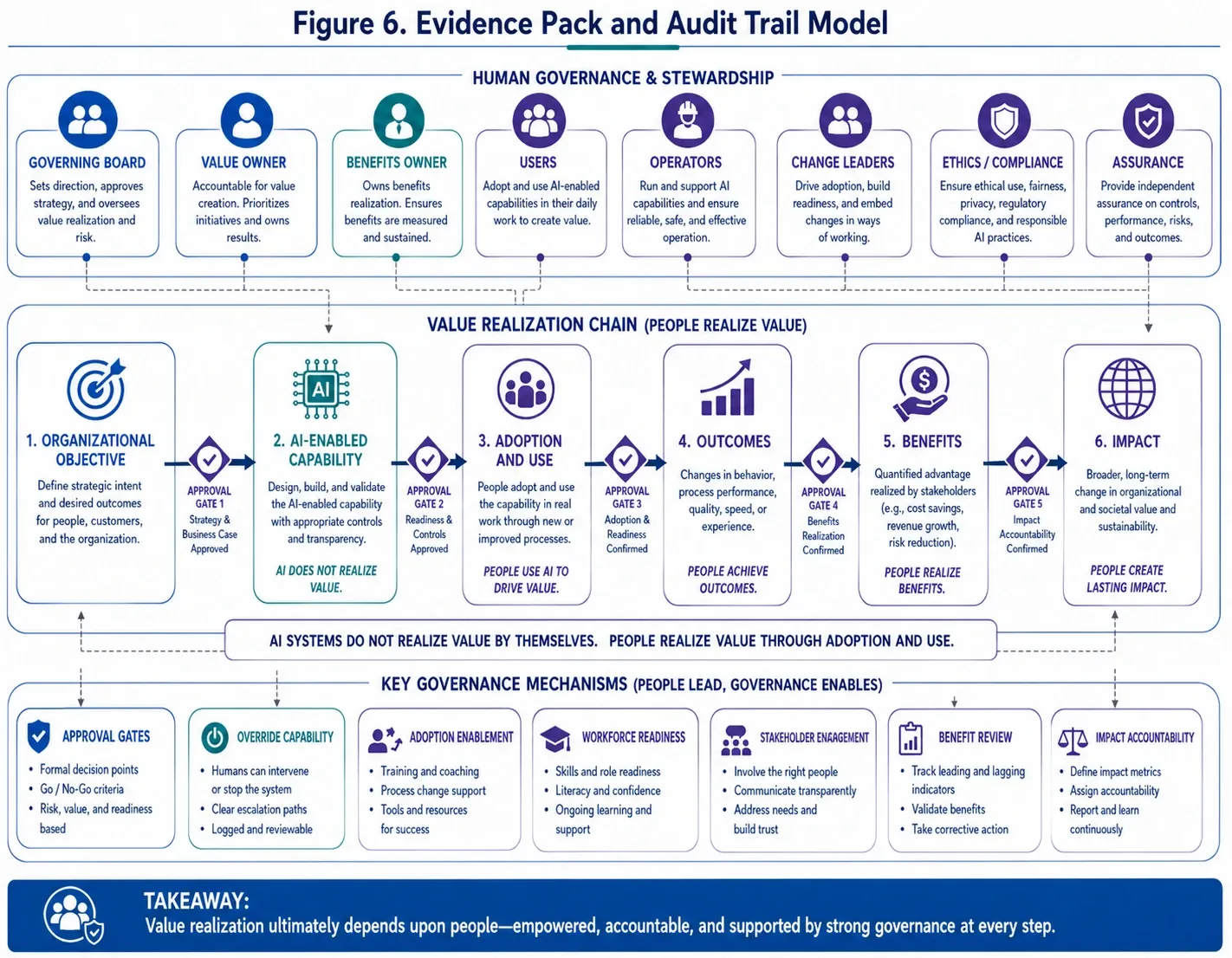
A model showing how governance decisions, approvals, overrides, assurance records, benefit reviews, and trigger responses become auditable evidence packs.
Figure 6. Evidence Pack and Audit Trail Model.
11. Human-in-Command Accountability Assets
11.1 Purpose
Human-in-Command accountability requires named authorities and evidence. The authority structure should be captured before deployment and reviewed when risk, autonomy, impact, or governance profile changes.
11.2 Accountability Matrix
Table 10. Human-in-Command accountability matrix.
| Authority Role | Accountability | Required Evidence |
|---|---|---|
| Strategic Authority | Sets strategic direction, investment priorities, risk appetite, and value expectations. | Strategic approval, investment decision, business case endorsement. |
| Governance Authority | Defines governance boundaries, profile, controls, and review cadence. | Governance profile approval, control requirements, board decision record. |
| Operational Authority | Manages execution, operating decisions, and intervention during delivery or operations. | Operational decision log, escalation record, incident response record. |
| Override Authority | Can suspend, intervene, override, or require adaptation when risk or value conditions require action. | Override delegation, override record, rationale, closure evidence. |
| Value Owner | Challenges value assumptions and determines whether continued investment remains justified. | Value review, net impact assessment, continue/adapt/pause/retire recommendation. |
| Benefits Owner | Defines, tracks, validates, and reports benefit realization. | Benefits register, baseline, target, realization evidence, drift review. |
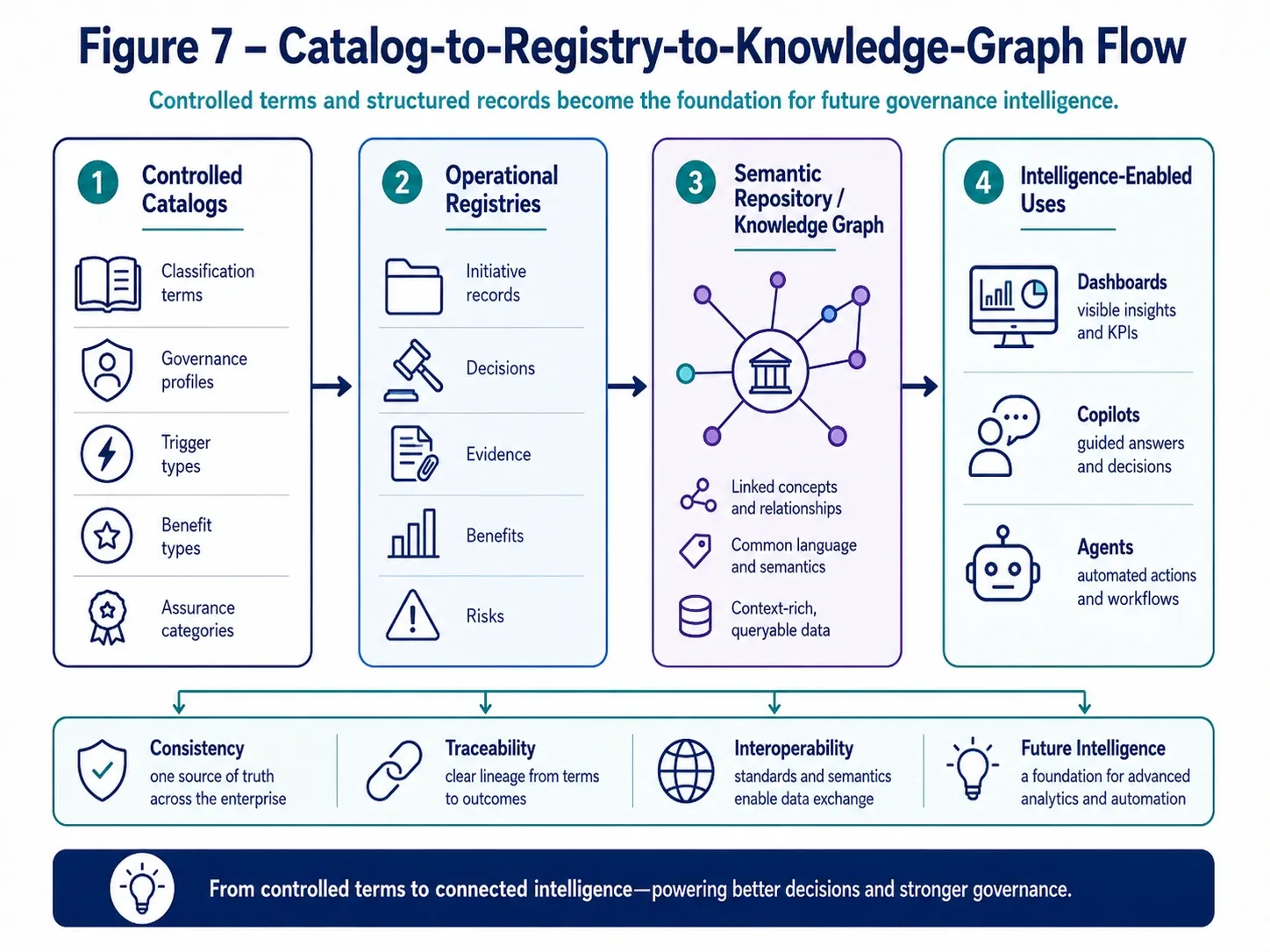
A flow showing how controlled catalogs populate registries and later support semantic repositories, knowledge graphs, dashboards, copilots, and agents.
Figure 7. Catalog-to-Registry-to-Knowledge-Graph Flow.
12. Benefits and Net Impact Mapping Templates
12.1 Purpose
The benefits and net impact templates preserve the framework distinction between outputs, outcomes, benefits, impacts, and net impact. This separation prevents delivery success from being mistaken for value realization.
12.2 Mapping Template
Table 11. Output-outcome-benefit-impact-net impact mapping template.
| Layer | Definition | Template Fields |
|---|---|---|
| Output | Immediate deliverable produced by the initiative. | Output description, owner, completion evidence, acceptance criteria. |
| Outcome | Observable change in behavior, performance, capability, or experience. | Outcome statement, affected process, indicator, baseline, timing. |
| Benefit | Measurable advantage generated by outcomes. | Benefit name, category, metric, baseline, target, owner, confidence level. |
| Impact | Broader organizational, human, societal, environmental, or strategic effect. | Impact type, affected stakeholders, evidence, positive and negative effects. |
| Net Impact | Aggregate value after benefits, costs, risks, disbenefits, unintended consequences, and sustainability effects. | Net impact statement, decision implication, review date, Value Owner recommendation. |
12.3 Benefit Drift Fields
- Expected benefit.
- Actual benefit.
- Variance from target.
- Confidence level.
- Adoption signal.
- Reason for drift.
- Corrective action.
- Owner and next review date.
13. Governance Trigger Catalog and Register
13.1 Purpose
The trigger catalog defines what types of events, signals, thresholds, or changes require governance attention. The trigger register captures what happened, how severe it was, who responded, and what evidence supports closure.
13.2 Trigger Catalog
Table 12. Canonical governance trigger categories.
| Trigger Category | Example Signals | Typical Owner |
|---|---|---|
| Financial | Cost variance, ROI deterioration, funding constraint, unexpected cost of control. | Sponsor, finance, Value Owner. |
| Operational | Service degradation, workflow failure, throughput decline, process disruption. | Operational owner. |
| Benefit | Benefit shortfall, adoption decline, benefit confidence reduction. | Benefits Owner, Value Owner. |
| Ethical | Fairness concern, transparency issue, stakeholder harm, unacceptable use. | Governance board, ethics owner. |
| Regulatory | New regulation, audit finding, compliance breach, external reporting requirement. | Compliance or legal function. |
| Data | Data drift, quality issue, lineage gap, privacy concern, sovereignty issue. | Data owner, data steward. |
| Vendor | Service disruption, contractual change, lock-in risk, performance failure. | Vendor manager, procurement. |
| Human Impact | Workforce displacement concern, user resistance, cognitive burden, rights impact. | Change lead, HR, governance board. |
| Sustainability | Energy use issue, ESG reporting impact, environmental consequence. | Sustainability owner. |
| Safety | Safety incident, near miss, unsafe recommendation, hazard condition. | Safety owner. |
| Strategic | Misalignment, portfolio priority change, market condition change, mission relevance decline. | Sponsor, portfolio governance board. |
13.3 Trigger Register Fields
Table 13. Governance trigger register fields.
| Field | Purpose |
|---|---|
| Trigger ID | Unique identifier. |
| Related Initiative ID | Links trigger to initiative registry. |
| Signal / Event | Describes what happened. |
| Category and Severity | Uses controlled catalog values. |
| Owner | Names accountable response owner. |
| Required Response | Monitor, review, escalate, intervene, pause, adapt, retire, or other action. |
| Evidence | Links to evidence pack. |
| Closure Status | Open, under review, closed, accepted risk, escalated, unresolved. |
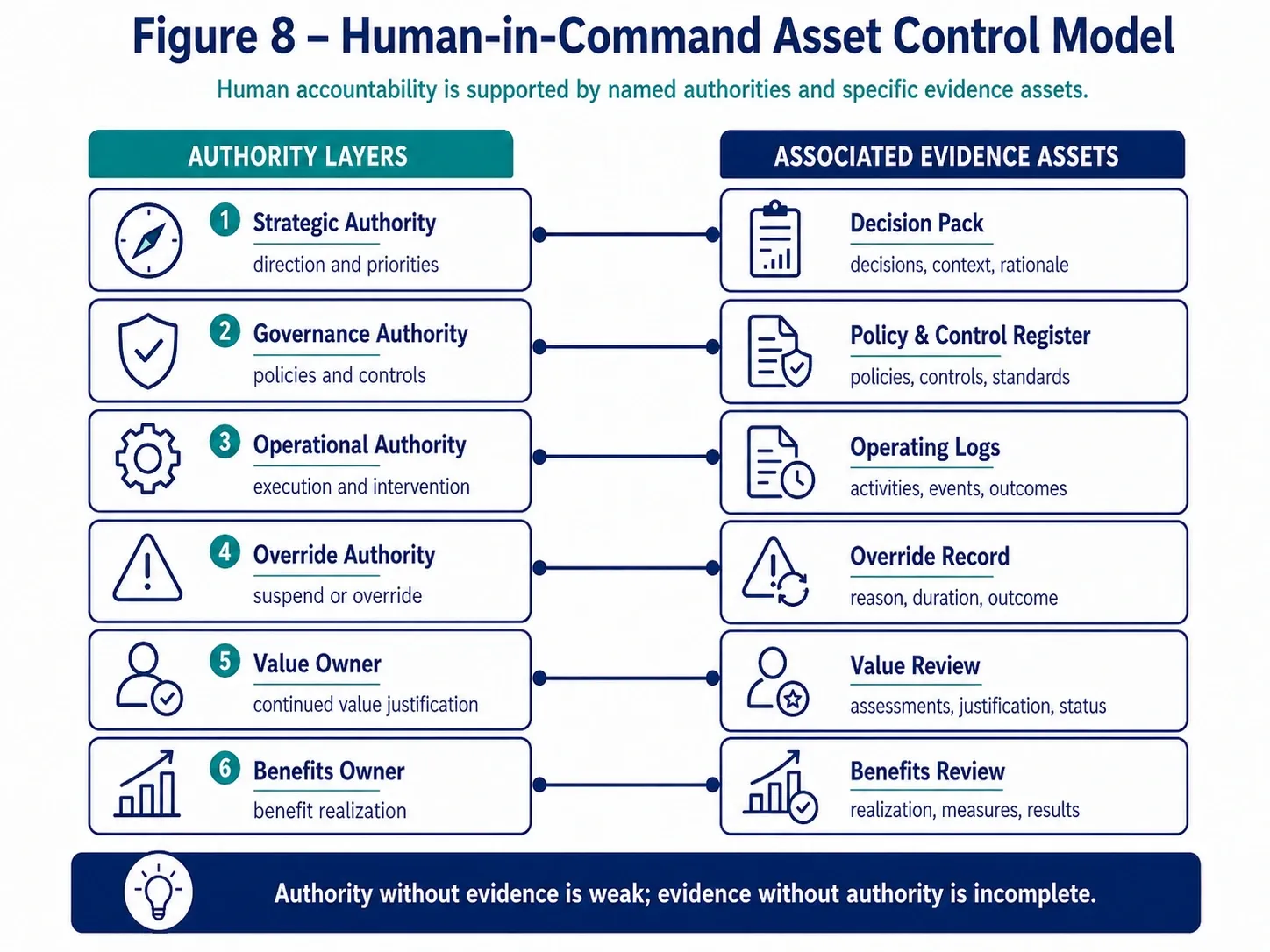
A control model showing strategic authority, governance authority, operational authority, override authority, Value Owner, Benefits Owner, and associated evidence assets.
Figure 8. Human-in-Command Asset Control Model.
14. Drift Monitoring and Benefits Register
14.1 Purpose
Drift monitoring should extend beyond model performance. The framework recognizes model drift, data drift, benefit drift, vendor drift, strategic drift, and governance drift as potential causes of value deterioration.
14.2 Drift Register Structure
Table 14. Drift register structure.
| Drift Type | Typical Indicators | Governance Response |
|---|---|---|
| Model Drift | Performance deterioration, accuracy change, increased error rate. | Model validation, retraining, pause or restriction. |
| Data Drift | Data distribution change, missing fields, quality decline, lineage gap. | Data review, source correction, control update. |
| Benefit Drift | Benefits below target, adoption decline, increased workarounds. | Benefit review, change intervention, business case update. |
| Vendor Drift | Vendor performance decline, service changes, dependency risk. | Vendor review, contract action, contingency plan. |
| Strategic Drift | Objective changes, portfolio priority shift, external condition change. | Strategic reassessment, adapt, pause, or retire. |
| Governance Drift | Controls no longer fit risk, review cadence weakens, evidence gaps. | Governance profile reassessment, control redesign. |
14.3 Benefits Register Fields
- Benefit ID, benefit name, benefit category, owner, baseline, target, actual value, confidence level, measurement source, review cadence, drift status, corrective action, and net impact implication.
15. Assurance, Validation, and Responsible AI Templates
15.1 Purpose
Assurance templates provide confidence that governance expectations are being met. Assurance should be proportionate to human impact, autonomy, regulatory exposure, data sensitivity, uncertainty, and governance complexity.
15.2 Assurance Plan Template
Table 15. Assurance plan template.
| Assurance Layer | Example Activities | Evidence |
|---|---|---|
| Technical Assurance | Model validation, performance testing, robustness testing, failure recovery testing. | Validation report, test evidence, exception log. |
| Data Assurance | Data quality assessment, lineage review, privacy review, sensitivity classification. | Data assessment, lineage record, access review. |
| Governance Assurance | Profile review, authority assignment check, decision traceability, evidence completeness. | Governance review record, authority registry, decision log. |
| Ethical Assurance | Fairness assessment, transparency review, stakeholder impact assessment. | Responsible AI review record, stakeholder evidence. |
| Operational Assurance | Readiness review, monitoring test, trigger test, escalation simulation. | Deployment readiness record, monitoring dashboard, exercise record. |
15.3 Responsible AI Review Checklist
- Transparency requirements defined.
- Explainability expectations documented.
- Accountability and override authority assigned.
- Fairness and bias considerations assessed.
- Privacy, security, and access controls reviewed.
- Human oversight and Human-in-Command controls evidenced.
- Sustainability implications documented where relevant.
- Responsible generative AI use restrictions documented where applicable.
16. Governance Intelligence Readiness Assets
16.1 Purpose
Governance intelligence readiness assets prepare the organization for semantic repositories, knowledge graphs, dashboards, governance copilots, governance agents, and Semantic PMO capabilities. They do this by making governance information structured, consistent, traceable, and evidence grounded.
16.2 Readiness Asset Set
Table 16. Governance intelligence readiness assets.
| Asset | Purpose | Future Capability Enabled |
|---|---|---|
| Semantic Metadata Template | Defines metadata fields for initiatives, objectives, capabilities, benefits, controls, authorities, and evidence. | Semantic repositories, knowledge graphs. |
| Relationship Register | Captures relationships between objectives, capabilities, initiatives, outputs, outcomes, benefits, impacts, controls, triggers, authorities, decisions, and evidence. | Knowledge graph, traceability queries. |
| Evidence Grounding Standard | Defines required evidence quality for dashboards, copilots, and agents. | Governance dashboards, copilots. |
| Copilot Use Case Control Template | Defines approved user groups, sources, capabilities, limitations, review requirements, and logs. | Governance copilots. |
| Agent Control Register | Defines permitted tasks, policy boundaries, approval gates, override mechanisms, and audit logs. | Governance agents. |
| Semantic PMO Readiness Checklist | Assesses readiness for portfolio intelligence, semantic mapping, and adaptive governance. | Semantic PMO. |
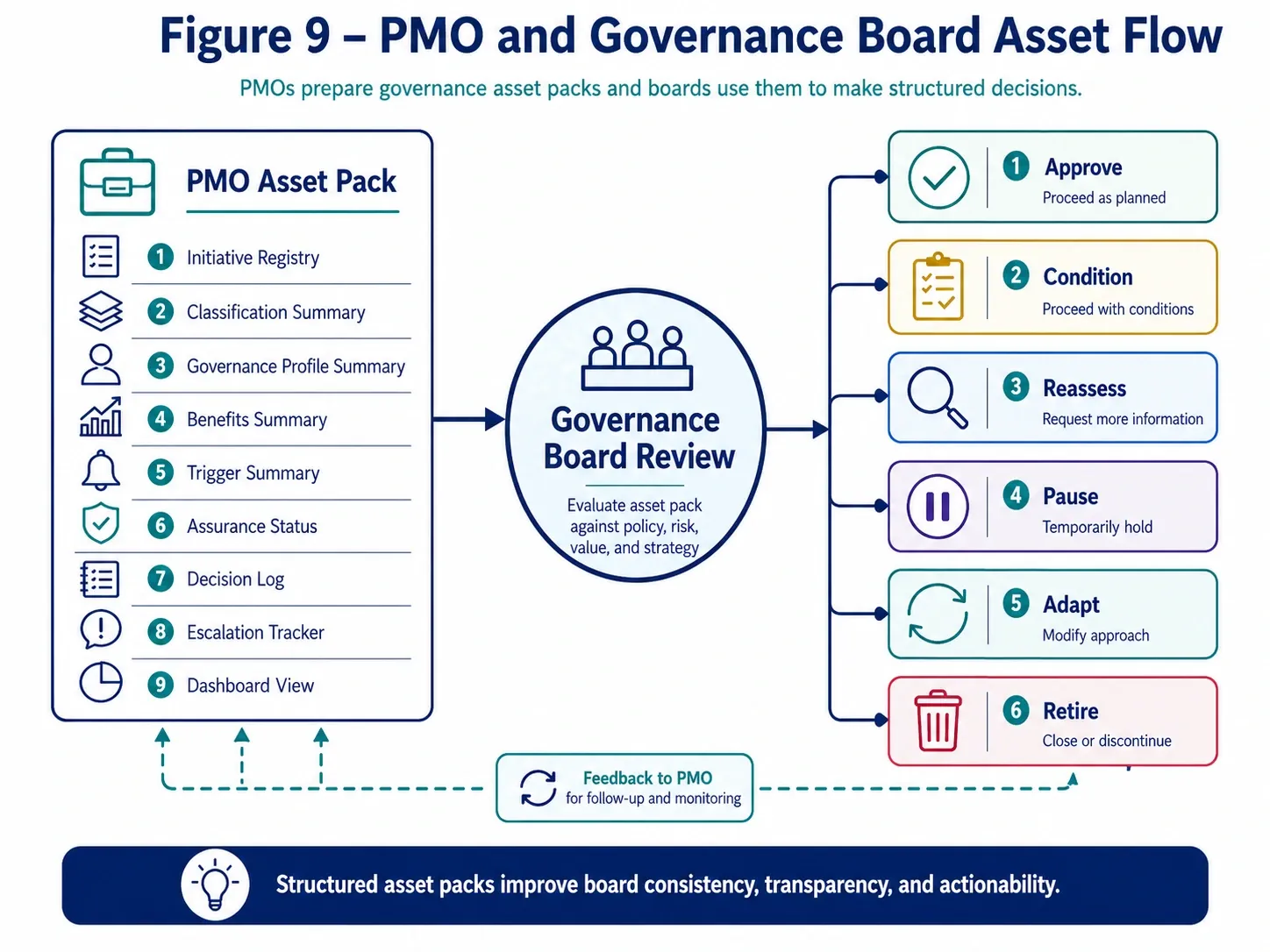
A flow showing how PMOs prepare asset packs and governance boards use them to approve, condition, reassess, pause, adapt, or retire initiatives.
Figure 9. PMO and Governance Board Asset Flow.
17. PMO and Governance Board Assets
17.1 PMO Asset Pack
The PMO asset pack supports consistent preparation of governance materials and portfolio-level visibility. It should include the initiative registry, portfolio governance dashboard view, classification summary, governance profile summary, benefits summary, trigger summary, assurance status, decision log, and escalation tracker.
17.2 Governance Board Asset Pack
Table 17. Governance board decision asset pack.
| Asset | Purpose |
|---|---|
| Decision Summary | States the decision requested and options available. |
| Business Case Extract | Summarizes strategic objective, capability, value proposition, and expected benefits. |
| Classification Summary | Presents the fourteen-dimensional classification and key governance implications. |
| Governance Profile Rationale | Explains proposed governance intensity and controls. |
| Human-in-Command Matrix | Names authorities and required evidence. |
| Benefit and Net Impact Summary | Shows expected benefits, impacts, disbenefits, and Value Owner recommendation. |
| Trigger and Monitoring Plan | Identifies trigger categories, severity thresholds, and owners. |
| Assurance Summary | Shows required and completed assurance activities. |
| Decision Record Template | Captures outcome, conditions, owner, evidence, and next review. |
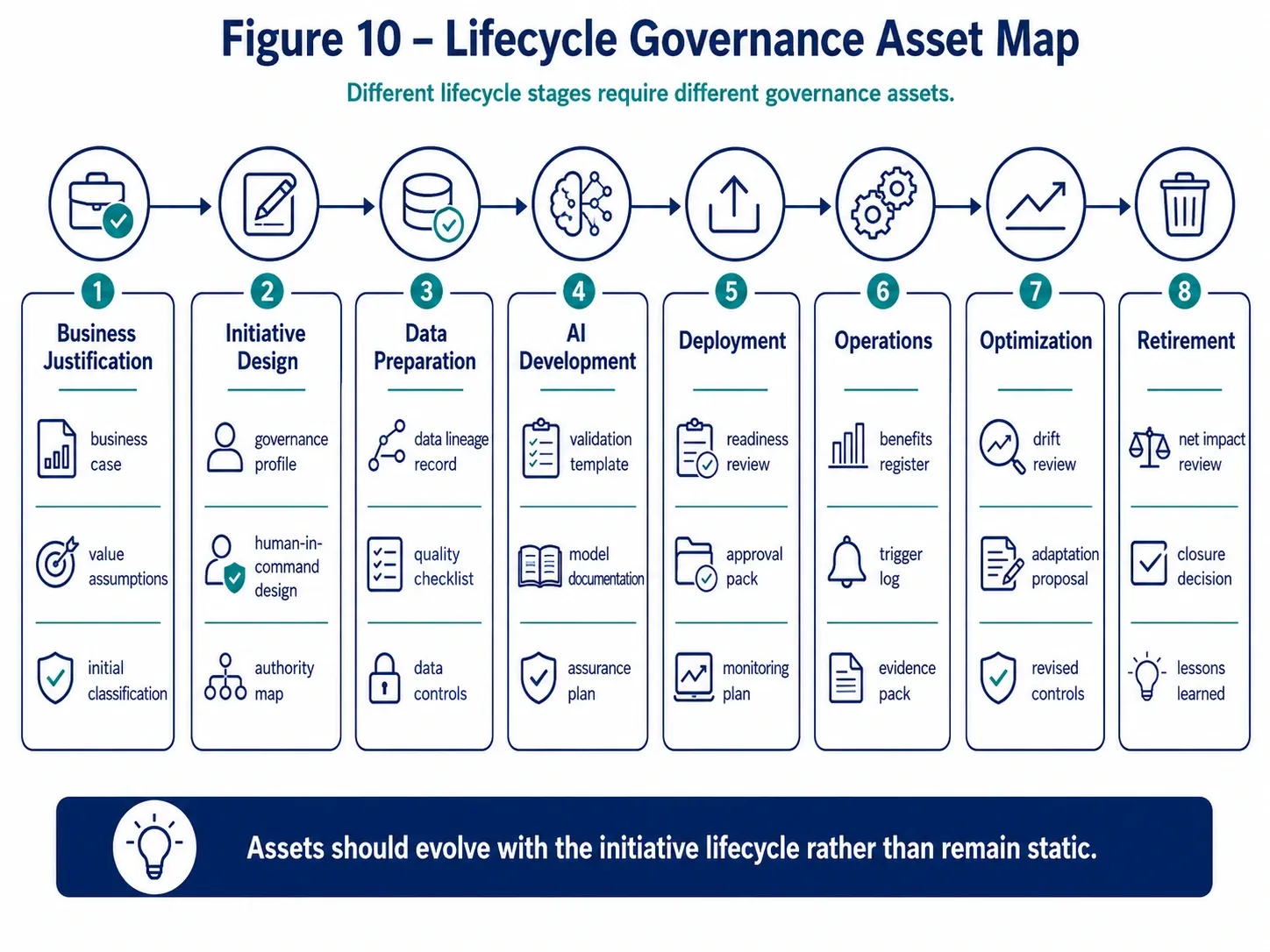
A lifecycle map showing the required assets for business justification, initiative design, data preparation, AI development, deployment, operations, optimization, and retirement.
Figure 10. Lifecycle Governance Asset Map.
18. Business Case and Decision Pack Templates
18.1 Business Case Template
AI-enabled business cases should be written as governance artifacts. They should make value assumptions, accountability, uncertainty, monitoring, and net impact visible from the start.
Table 18. AI-enabled business case required sections.
| No. | Section | Governance Purpose |
|---|---|---|
| 1 | Executive Summary | Summarize the initiative and requested decision. |
| 2 | Strategic Objective | Explain why the initiative exists. |
| 3 | Problem Statement | Define the problem and consequences of inaction. |
| 4 | Organizational Capability | Identify the capability being enhanced or created. |
| 5 | AI Role in PPPM | Explain how AI contributes to the initiative or governance environment. |
| 6 | Proposed Solution | Describe the AI-enabled capability. |
| 7 | Value Delivery Logic | Show output -> outcome -> benefit -> impact -> net impact. |
| 8 | Expected Outputs | Define delivery outputs. |
| 9 | Expected Outcomes | Define observable changes. |
| 10 | Expected Benefits | Define measurable advantages. |
| 11 | Expected Impacts | Define broader effects. |
| 12 | Net Impact Assessment | Assess value after costs, risks, disbenefits, unintended consequences, and sustainability effects. |
| 13 | Governance Profile | Assign governance intensity and rationale. |
| 14 | Human-in-Command Structure | Name accountable authorities. |
| 15 | Risks and Uncertainty | Document assumptions and uncertainty profile. |
| 16 | Responsible AI Assessment | Assess transparency, accountability, fairness, privacy, security, sustainability, and human oversight. |
| 17 | Benefits Realization Plan | Define owners, indicators, baselines, targets, and reviews. |
| 18 | Monitoring Plan | Define dashboards, indicators, and cadence. |
| 19 | Governance Triggers | Define trigger categories, thresholds, and response owners. |
| 20 | Recommendation | Request approval, conditional approval, reassessment, pause, adaptation, or retirement. |
18.2 Decision Pack Standard
Decision packs should be concise enough for governance board use but structured enough to preserve evidence. Every decision pack should identify the decision requested, alternatives considered, required evidence, decision owner, conditions, next review date, and expected impact on net value.
19. Lifecycle Governance Asset Pack
19.1 Purpose
Lifecycle governance assets ensure that governance remains adaptive. The assets should be used at business justification, initiative design, data preparation, AI development, deployment, operations, optimization, and retirement.
19.2 Lifecycle Asset Map
Table 19. Lifecycle governance asset map.
| Lifecycle Stage | Required Assets | Decision Question |
|---|---|---|
| Business Justification | Business case, classification draft, benefits hypothesis, governance profile draft. | Is the initiative worth exploring? |
| Initiative Design | Use case template, Human-in-Command matrix, trigger draft, assurance plan draft. | Is the initiative designed for accountable value delivery? |
| Data Preparation | Data governance profile, lineage record, privacy review, quality evidence. | Is the data fit for intended governance and AI use? |
| AI Development | Validation plan, explainability record, controls register, responsible AI review. | Is the capability trustworthy enough to progress? |
| Deployment | Readiness checklist, approval record, monitoring plan, escalation path. | Can the capability be deployed under defined governance conditions? |
| Operations | Benefits register, trigger register, incident log, evidence pack, drift register. | Is value being realized and are risks controlled? |
| Optimization | Change record, benefit drift review, profile reassessment, retraining evidence. | Should the initiative adapt? |
| Retirement | Net impact review, closure decision, lessons learned, evidence archive. | Should the initiative retire or be replaced? |
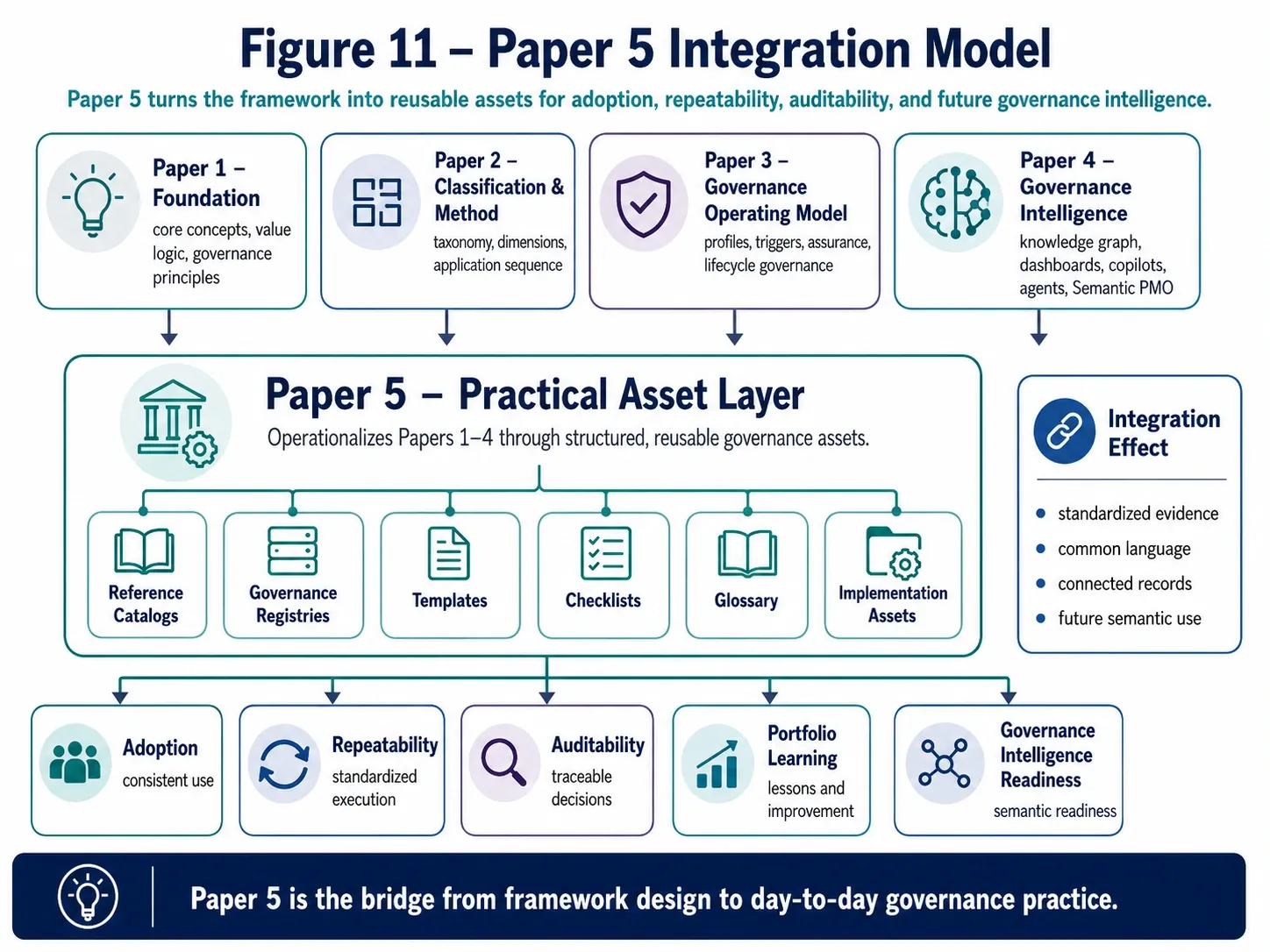
A final integration model showing how Paper 5 enables Papers 1 to 4 by providing practical assets for adoption, repeatability, auditability, and future governance intelligence.
Figure 11. Paper 5 Integration Model.
20. Asset Governance and Version Control
20.1 Asset Ownership
Each asset should have an owner, approver, review cycle, version history, change log, and retirement rule. Without asset governance, templates become inconsistent and registries lose reliability.
20.2 Version Control Standard
Table 20. Version control standard for Paper 5 assets.
| Element | Minimum Requirement |
|---|---|
| Version Number | Use major.minor numbering for released assets and draft labels for working versions. |
| Effective Date | State date from which the asset applies. |
| Change Description | Summarize what changed and why. |
| Approval Authority | Name the role or board approving the release. |
| Impacted Assets | Identify related templates, catalogs, registries, dashboards, or training materials. |
| Retired Values | Keep retired terms visible for historical audit, clearly marked as retired. |
20.3 Asset Lifecycle
- Create or revise asset.
- Review against framework terminology, governance need, and usability.
- Approve through the asset owner or governance office.
- Publish with version number and guidance.
- Use in governance activities and capture feedback.
- Review periodically and revise or retire when obsolete.
21. Adoption, Training, and Implementation Support
21.1 Adoption Approach
The Paper 5 assets should be rolled out progressively. Organizations should begin with the minimum viable asset set, apply it to pilot initiatives, improve usability based on practitioner feedback, and then scale through PMO routines and governance board decision cycles.
21.2 Minimum Viable Asset Set
Table 21. Minimum viable asset set.
| Asset | Why It Comes First |
|---|---|
| AI Initiative Definition Template | Establishes what is being governed. |
| Classification Worksheet | Enables consistent governance comparison. |
| Governance Profile Assessment | Defines governance intensity and controls. |
| Human-in-Command Matrix | Names accountable authorities. |
| Benefits and Net Impact Map | Connects delivery to value realization. |
| Trigger Register | Creates continuous governance awareness. |
| Decision Record | Preserves governance evidence. |
21.3 Training Needs
- PMO and governance office training on catalog ownership, registry discipline, and portfolio reporting.
- Governance board training on decision packs, governance profile rationale, and net impact review.
- Sponsor and business case author training on value delivery logic and uncertainty documentation.
- Delivery team training on governance-by-design evidence and readiness checklists.
- Value Owner and Benefits Owner training on benefit drift, net impact, and continue/adapt/pause/retire recommendations.
22. Summary
Paper 5 provides the reference assets and implementation templates required to adopt the AI Governance and Value Delivery Framework Series in practice. It converts conceptual structures, governance operating logic, practical application methods, and future governance intelligence readiness into usable assets.
The asset library should enable organizations to use consistent terminology, compare initiatives, document governance decisions, assign Human-in-Command accountability, monitor benefits and drift, manage triggers, support assurance, and prepare for governance intelligence evolution.
The framework remains grounded in the same propositions: AI initiatives are value delivery systems; governance should be adaptive and continuous; human accountability remains essential; and net impact determines whether value is created, neutral, or destroyed.
Paper 5 completes the five-paper series by providing the practical adoption layer: the catalogs, registries, templates, glossary, and implementation assets needed to make governance repeatable, auditable, and intelligence-ready.
Integration statement: Papers 1 to 4 define what the framework is and how it evolves. Paper 5 defines the assets through which the framework is adopted, evidenced, improved, and scaled.
References
- Project Management Institute. A Guide to the Project Management Body of Knowledge (PMBOK® Guide) - Eighth Edition and The Standard for Project Management.
- Project Management Institute. The Standard for Artificial Intelligence in Portfolio, Program and Project Management.
- National Institute of Standards and Technology. Artificial Intelligence Risk Management Framework (AI RMF 1.0).
- International Organization for Standardization. ISO/IEC 42001:2023 - Information technology - Artificial intelligence - Management system.
- International Organization for Standardization. ISO/IEC 23894:2023 - Information technology - Artificial intelligence - Guidance on risk management.
- Organization for Economic Co-operation and Development. OECD AI Principles.
- AI Governance and Value Delivery Ontology and Taxonomy Framework Series. Papers 1-5.
Appendix A - AI Initiative Definition Template
Table A1. AI initiative definition template.
| Field | Entry |
|---|---|
| Initiative Name | |
| Initiative ID | |
| Sponsor | |
| PMO / Portfolio | |
| Organizational Objective | |
| Business Capability | |
| Problem / Opportunity | |
| AI-enabled Value Stream | |
| Primary Stakeholders | |
| Lifecycle Stage | |
| Initial Governance Profile | |
| Date Prepared | |
| Prepared By |
Appendix B - AI Initiative Classification Worksheet
Table B1. Fourteen-dimensional classification worksheet.
| No. | Dimension | Catalog Value / Assessment | Rationale |
|---|---|---|---|
| 1 | AI Role in PPPM | ||
| 2 | AI Capability Type | ||
| 3 | AI Problem Pattern | ||
| 4 | Business Intent | ||
| 5 | Value Profile | ||
| 6 | Governance Profile | ||
| 7 | Financial Profile | ||
| 8 | Data Dependency Profile | ||
| 9 | AI Quality and Reliability Profile | ||
| 10 | Human Impact Profile | ||
| 11 | Change Management and Organizational Readiness Profile | ||
| 12 | Adoption Profile | ||
| 13 | Vendor Dependency Profile | ||
| 14 | Sustainability Profile |
Appendix C - Governance Profile Assessment Template
Table C1. Governance profile assessment template.
| Assessment Area | Score | Rationale | Required Control |
|---|---|---|---|
| Human Impact | Low / Medium / High / Extreme | ||
| Regulatory Exposure | Low / Medium / High / Extreme | ||
| Autonomy | Low / Medium / High / Extreme | ||
| Data Sensitivity | Low / Medium / High / Extreme | ||
| Stakeholder Sensitivity | Low / Medium / High / Extreme | ||
| Uncertainty | Low / Medium / High / Extreme | ||
| Reversibility of Harm | Low / Medium / High / Extreme | ||
| Sustainability Consequences | Low / Medium / High / Extreme |
Proposed Governance Profile: ______________________________
Approval / Conditions: ______________________________
Appendix D - Human-in-Command Accountability Matrix
Table D1. Accountability matrix template.
| Role | Named Person / Body | Authority Scope | Evidence Required |
|---|---|---|---|
| Strategic Authority | |||
| Governance Authority | |||
| Operational Authority | |||
| Override Authority | |||
| Value Owner | |||
| Benefits Owner | |||
| Assurance Owner | |||
| Data Owner |
Appendix E - Governance Trigger Register
Table E1. Governance trigger register template.
| Trigger ID | Category | Signal / Event | Severity | Owner | Response | Status |
|---|---|---|---|---|---|---|
| Informational / Moderate / Significant / Critical | ||||||
| Informational / Moderate / Significant / Critical | ||||||
| Informational / Moderate / Significant / Critical | ||||||
| Informational / Moderate / Significant / Critical |
Appendix F - Benefits and Net Impact Register
Table F1. Benefits and net impact register template.
| Benefit / Impact | Metric | Baseline | Target | Actual | Owner | Drift Status |
|---|---|---|---|---|---|---|
| Output | ||||||
| Outcome | ||||||
| Benefit | ||||||
| Impact | ||||||
| Net Impact |
Appendix G - Responsible AI Review Checklist
Table G1. Responsible AI review checklist.
| Review Area | Question | Status | Evidence |
|---|---|---|---|
| Transparency | Are users and stakeholders informed about the AI-enabled capability? | [ ] Open [ ] Complete [ ] N/A | |
| Explainability | Are explanations appropriate for the decision context? | [ ] Open [ ] Complete [ ] N/A | |
| Accountability | Are Human-in-Command authorities assigned? | [ ] Open [ ] Complete [ ] N/A | |
| Fairness | Have fairness and bias risks been assessed? | [ ] Open [ ] Complete [ ] N/A | |
| Privacy | Have privacy obligations been assessed? | [ ] Open [ ] Complete [ ] N/A | |
| Security | Have security controls been defined? | [ ] Open [ ] Complete [ ] N/A | |
| Traceability | Are decisions, evidence, and assumptions traceable? | [ ] Open [ ] Complete [ ] N/A | |
| Sustainability | Have sustainability implications been considered? | [ ] Open [ ] Complete [ ] N/A |
Appendix H - Assurance and Validation Plan Template
Table H1. Assurance and validation plan template.
| Assurance Area | Activity | Owner | Timing | Evidence |
|---|---|---|---|---|
| Technical Assurance | ||||
| Data Assurance | ||||
| Governance Assurance | ||||
| Ethical Assurance | ||||
| Operational Assurance | ||||
| Human Override Test | ||||
| Deployment Readiness Review |
Appendix I - Governance Intelligence Metadata Template
Table I1. Semantic metadata template.
| Entity | Required Metadata | Relationship Fields |
|---|---|---|
| Objective | ID, name, owner, strategic priority. | Supports capability; justifies initiative. |
| Capability | ID, name, owner, maturity. | Enables objective; shaped by initiative. |
| Initiative | ID, name, sponsor, profile, stage. | Creates output; governed by controls; reviewed by board. |
| Output | ID, description, owner, acceptance evidence. | Leads to outcome. |
| Outcome | ID, indicator, baseline, target. | Realizes benefit. |
| Benefit | ID, metric, owner, target, confidence. | Contributes to impact. |
| Impact | ID, type, stakeholder group, evidence. | Determines net impact. |
| Control | ID, owner, requirement, test method. | Governs initiative or output. |
| Trigger | ID, category, severity, threshold. | Activates response or decision. |
| Evidence | ID, source, date, integrity status. | Verifies decision, control, benefit, or outcome. |
Appendix J - Governance Board Decision Record Template
Table J1. Governance board decision record template.
| Field | Entry |
|---|---|
| Decision ID | |
| Initiative ID | |
| Decision Date | |
| Decision Type | Approve / Approve with Conditions / Reassess / Pause / Adapt / Retire |
| Decision Rationale | |
| Evidence Reviewed | |
| Conditions | |
| Accountable Owner | |
| Next Review Date | |
| Escalation Required | Yes / No |
Appendix K - Glossary of Key Terms
Table K1. Glossary of key terms.
| Term | Definition |
|---|---|
| AI-enabled Initiative | Any project, program, product, operational capability, governance capability, or transformation activity in which AI materially contributes to outputs, outcomes, benefits, impacts, or decisions. |
| Benefit Drift | A condition in which expected benefits diverge from realized benefits, even when technical performance may remain acceptable. |
| Governance Profile | A classification-based governance tailoring category that defines oversight intensity, assurance requirements, human authority requirements, escalation pathways, monitoring expectations, and trigger sensitivity. |
| Governance Registry | A structured record used to capture governance objects, decisions, authorities, benefits, triggers, controls, evidence, or lessons learned. |
| Human-in-Command | The accountability principle that humans retain ultimate authority, judgment, and accountability for AI-enabled governance and value delivery decisions. |
| Net Impact | The aggregate effect of benefits, costs, risks, disbenefits, unintended consequences, and sustainability effects. |
| Reference Catalog | A controlled vocabulary or structured reference list used to support consistency across classification, governance, and reporting. |
| Semantic PMO | A future-state PMO capability that uses structured governance knowledge, semantic relationships, and intelligence services to support portfolio value, governance consistency, accountability, and adaptive decision-making. |
| Trigger | A signal, event, threshold, or condition that requires monitoring, review, escalation, intervention, adaptation, or retirement action. |
| Value Owner | The role accountable for continued value justification and net impact review. |
Appendix L - Implementation Roadmap Checklist
Table L1. Implementation roadmap checklist.
| Phase | Checklist Items |
|---|---|
| Phase 1 - Foundation | [ ] Governance sponsor named[ ] Minimum viable asset set approved[ ] Catalog owner assigned[ ] Pilot initiatives selected |
| Phase 2 - Pilot Application | [ ] Classification worksheets completed[ ] Governance profiles assigned[ ] Human-in-Command matrices completed[ ] Trigger registers created |
| Phase 3 - Portfolio Integration | [ ] Initiative registry operational[ ] Benefits register operational[ ] Decision records standardized[ ] Portfolio dashboard requirements defined |
| Phase 4 - Enterprise Adoption | [ ] Training delivered[ ] Asset version control active[ ] Assurance templates adopted[ ] Governance board cadence aligned |
| Phase 5 - Governance Intelligence Readiness | [ ] Semantic metadata captured[ ] Relationship register populated[ ] Evidence quality standard active[ ] Copilot and agent controls defined |
Note:
| Framework Series | AI Governance and Value Delivery Ontology and Taxonomy Framework |
|---|---|
| Document Role | Practical reference asset library and implementation toolkit |
| Primary Users | PMOs, governance boards, sponsors, Value Owners, Benefits Owners, delivery teams, assurance teams |
| Date | June 11, 2026 |